7 Portfolio Diversification Mistakes Accredited Investors Keep Making (And How to Fix Them)
- Technical Support
.png/v1/fill/w_320,h_320/file.jpg)
- Jan 16
- 5 min read
Let's be honest. You didn't become an accredited investor by accident. You've built wealth, made smart decisions, and probably know more about markets than most people ever will.
But here's the thing, even seasoned investors fall into the same diversification traps over and over again. And these mistakes? They're costing real money.
I've seen portfolios that look diversified on paper but crumble when a single sector tanks. I've watched investors spread themselves so thin they can't keep track of what they own. And I've seen brilliant people miss out on massive opportunities because they stuck to the same playbook from 2005.
Let's break down the seven mistakes I see most often, and more importantly, how to fix them.
Mistake #1: Confusing "Many Holdings" with "True Diversification"
This one trips up smart people all the time.
You own 15 different tech stocks, 3 crypto tokens that all move together, and a handful of growth-focused ETFs. That's diversified, right?
Not really.
If everything in your portfolio reacts the same way to market conditions, you're not diversified, you're just holding variations of the same bet. When tech crashes, all those holdings crash together. Correlation is the hidden killer of fake diversification.
The Fix: Look at how your investments actually behave relative to each other. True diversification means owning assets that don't move in lockstep. A portfolio with stocks, real estate, private equity, and yes, institutional-grade crypto, gives you genuine protection because these asset classes respond differently to economic shifts.

Mistake #2: Ignoring Alternative Investments Entirely
Here's where accredited investors have a massive advantage most don't fully use.
You have access to private equity deals, hedge funds, real estate syndications, and institutional Bitcoin strategies that regular retail investors can only dream about. Yet many accredited investors stick exclusively to public markets.
Why? Usually it's familiarity. Stocks and bonds feel comfortable. Alternatives feel complicated.
But comfort isn't a strategy. And in today's environment, traditional 60/40 portfolios don't provide the protection they once did.
The Fix: Consider what we call the 40/30/30 model, 40% traditional equities, 30% fixed income and real assets, and 30% alternatives including private equity and digital assets. This blend gives you growth potential, income stability, and uncorrelated returns that can cushion downturns.
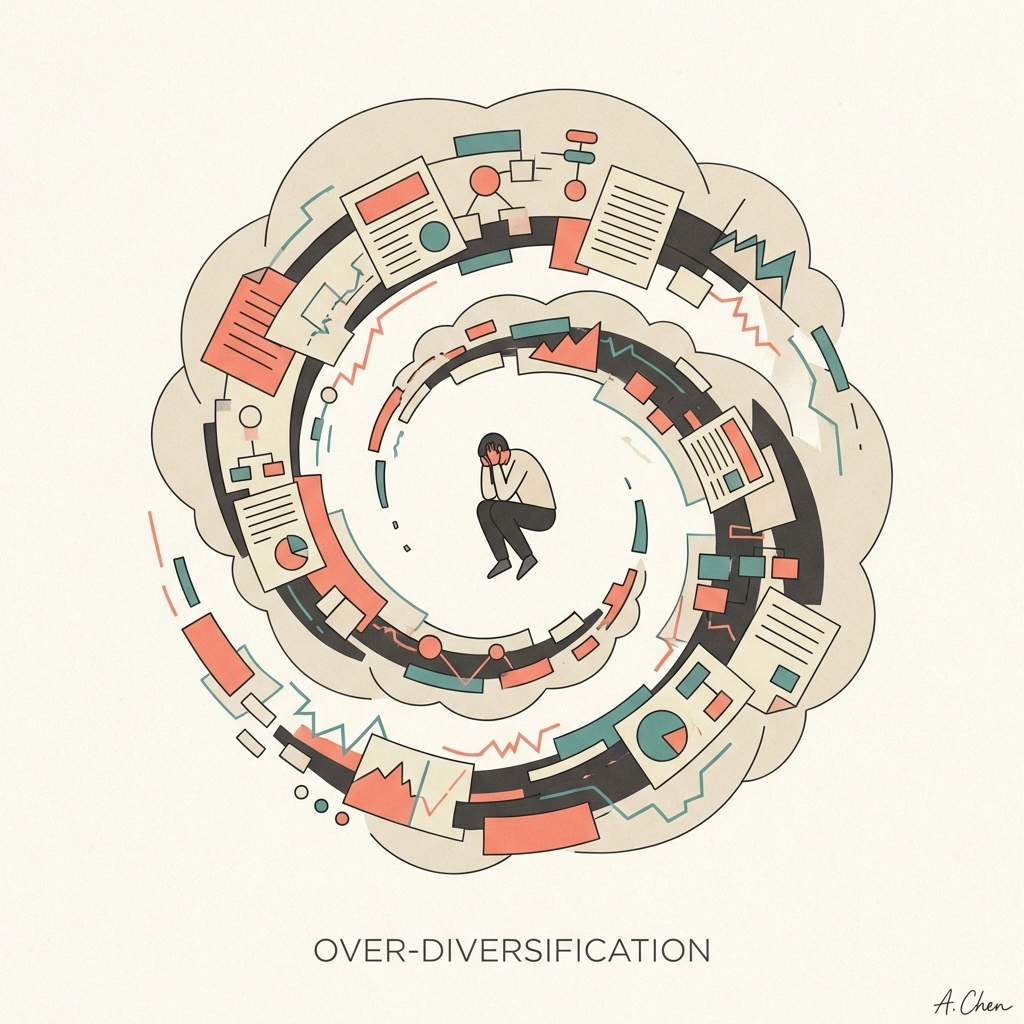
Mistake #3: Over-Diversification (Yes, That's a Thing)
Peter Lynch famously called this "diworsification": and the name stuck for good reason.
Some investors go overboard. They own 50+ positions across every asset class imaginable. Sounds safe, but it creates real problems:
You can't possibly track everything
Returns get diluted to near-index levels (minus higher fees)
Rebalancing becomes a nightmare
Transaction costs quietly eat your gains
At some point, adding more holdings doesn't reduce risk: it just adds complexity.
The Fix: Find your sweet spot. Most research suggests diversification benefits plateau after 20-30 uncorrelated positions. Beyond that, you're just making your life harder without meaningful risk reduction. Quality over quantity matters here.

Mistake #4: Underestimating Illiquidity Risk
This hits venture capital and private equity investors hard.
You put a significant chunk into a promising startup fund or real estate syndication. Great opportunity. But now that capital is locked up for 7-10 years. Then life happens: you need liquidity for a business opportunity, a health situation, or simply because markets shifted.
Too much illiquid capital creates real problems, even if those investments are performing well.
The Fix: Be honest about your liquidity needs. A general rule: keep at least 60-70% of your portfolio in assets you can access within a reasonable timeframe. Alternatives and private investments should complement your liquid holdings, not dominate them.
Also, mentally prepare for the possibility that some venture investments won't pan out. That's the nature of the game. Position sizing matters.
Mistake #5: Misaligning Risk Tolerance with Risk Capacity
These are two different things, and confusing them leads to bad decisions.
Risk tolerance is psychological: how much volatility can you stomach without panic-selling at the worst possible time?
Risk capacity is mathematical: how much can you actually afford to lose without derailing your financial goals?
Some investors have high capacity but low tolerance. Others have the opposite. Problems arise when your portfolio doesn't match both.
The Fix: Be brutally honest with yourself. If a 30% drawdown would keep you up at night, don't build a portfolio that could experience one: even if you could technically afford the loss. And if you're approaching retirement or have near-term liquidity needs, your capacity may be lower than you think regardless of your comfort level.
Reassess these factors regularly. They change as your life changes.
Mistake #6: Skipping Bitcoin and Digital Assets Entirely
Look, I get the skepticism. Crypto has had its share of bad actors and wild volatility.
But here's what's changed: institutional infrastructure now exists. Regulated custodians, ETF products, and sophisticated hedging strategies have made Bitcoin a legitimate portfolio allocation for serious investors.
More importantly, Bitcoin has demonstrated genuine uncorrelation benefits during certain market conditions. It's not a magic bullet, but dismissing it entirely means leaving a potentially valuable diversification tool on the table.
The Fix: Consider a measured allocation: typically 2-5% for conservative portfolios, potentially higher for those with longer time horizons and higher risk capacity. The key is accessing it through institutional-grade solutions with proper custody and risk management, not speculating on meme coins through retail exchanges.
At Mogul Strategies, we specialize in blending traditional assets with digital strategies in a way that makes sense for sophisticated investors.
Mistake #7: Operating Without Clear Investment Goals
This might be the most fundamental mistake of all.
Without defined objectives, every shiny new opportunity looks attractive. You end up with a hodgepodge of positions that don't work together toward any coherent purpose.
Are you building generational wealth? Generating income for retirement? Preserving capital? Maximizing growth? Each goal requires a different approach.
The Fix: Write down your actual objectives. Not vague ideas: specific targets with timeframes. "Generate $15,000 monthly passive income within 10 years" is a goal. "Grow my wealth" is not.
Once you have clarity, every investment decision becomes easier. Does this holding move me toward my goal? If not, why is it in my portfolio?

Putting It All Together
Here's the reality: diversification isn't about checking boxes or hitting some magic number of holdings. It's about intentionally constructing a portfolio where the pieces work together while responding differently to market conditions.
For accredited investors specifically, this means:
Leveraging your access to alternatives, private equity, and institutional-grade digital assets
Balancing liquidity so you're not locked into illiquid positions you can't afford to hold
Managing correlation across your entire portfolio, not just within asset classes
Aligning everything with clear goals and honest risk assessment
The investors who get this right don't just survive market volatility: they use it as an opportunity while others panic.
Ready to Rethink Your Approach?
At Mogul Strategies, we help accredited investors build portfolios that blend traditional assets with innovative digital strategies. No cookie-cutter solutions: just thoughtful allocation designed for sophisticated wealth builders.
If you're ready to move beyond the same old diversification mistakes, let's talk.
Comments