How to Build a $10M+ Portfolio with Crypto and Real Estate Integration (Step-by-Step for Accredited Investors)
- Technical Support
.png/v1/fill/w_320,h_320/file.jpg)
- 6 days ago
- 5 min read
Most accredited investors are still thinking about crypto and real estate as separate buckets. You've got your income-producing properties over here, maybe some Bitcoin in a cold wallet over there, and they don't really talk to each other.
That's leaving money on the table.
The smartest institutional players are now building hybrid portfolios that use real estate cash flow to systematically accumulate digital assets. It's not speculation: it's a disciplined framework that solves one of crypto's biggest problems: what do you do when the market tanks and you need liquidity?
Here's how to actually build this kind of portfolio if you're working with $10 million or more.
Why the Hybrid Model Makes Sense Right Now

Traditional 60/40 portfolios (stocks and bonds) haven't worked the same way since 2022. Bonds and stocks fell together, correlation broke down, and everyone's looking for better diversification.
At the same time, Bitcoin has matured. We've got spot ETFs, institutional custody solutions, and major corporations adding it to their balance sheets. It's no longer fringe: it's infrastructure.
But here's the catch: Bitcoin-only strategies have a fatal flaw. When the market drops 50% (and it will), you either panic sell, take on debt, or sit frozen. None of those are good options.
Real estate solves this. Income-producing properties generate consistent cash flow regardless of Bitcoin's price. That rental income becomes your Bitcoin accumulation engine, letting you buy through every market cycle without forced liquidation.
The Core Framework: Cash Flow Funds Digital Asset Growth
Think of this as two engines working together:
Engine 1: Institutional-Grade Real Estate You're not buying single-family rentals here. We're talking multifamily properties, commercial real estate, or syndication deals that produce serious net operating income (NOI). The goal is predictable, substantial cash flow: ideally $500K to $2M+ annually on a $10M+ portfolio allocation.
Engine 2: Systematic Bitcoin Accumulation All or most of that real estate cash flow gets converted to Bitcoin using dollar-cost averaging. You're not timing the market. You're not guessing. You're building a treasury that compounds over decades.
This is exactly what firms like Cardone Capital are doing at scale: they acquired a $235 million multifamily property generating about $10 million in annual NOI, then directed that entire cash flow stream toward Bitcoin purchases. Individual accredited investors can replicate this model proportionally.
Step 1: Determine Your Real Estate Allocation ($5M-$7M)

Start with 50-70% of your total portfolio in cash-flowing real estate. For a $10M portfolio, that's $5-7 million.
Your options:
Multifamily Syndications: You invest as a limited partner in institutional-grade apartment complexes. Typical returns are 6-8% annual cash-on-cash, with operators handling everything. Minimum investments usually start at $50K-$100K per deal.
Commercial Real Estate: Office buildings, retail centers, or industrial properties with long-term triple-net leases. More stable but potentially lower yields.
Real Estate Investment Trusts (Private REITs): Accredited-investor-only REITs that aren't publicly traded. Less liquidity but better returns than public REITs: often 8-12% annually.
The key metric: net cash flow to you after all expenses, debt service, and fees. You need real money hitting your account quarterly or monthly that you can redirect toward crypto.
Step 2: Set Up Your Bitcoin Treasury Structure ($2M-$3M)
With 20-30% of your portfolio ($2-3 million initially), you're establishing your Bitcoin position. This isn't your entire crypto allocation long-term: it's your starting foundation.
Custody matters here. You have three institutional-grade options:
Qualified custodians like Fidelity Digital Assets or Coinbase Prime (for accounts over $1M)
Multi-signature cold storage through providers like Casa or Unchained Capital
Regulated trust companies that specialize in digital asset custody for high-net-worth clients
Don't use consumer exchanges for this size allocation. Security and insurance requirements are completely different at institutional scale.
Step 3: Create the Cash Flow Conversion System
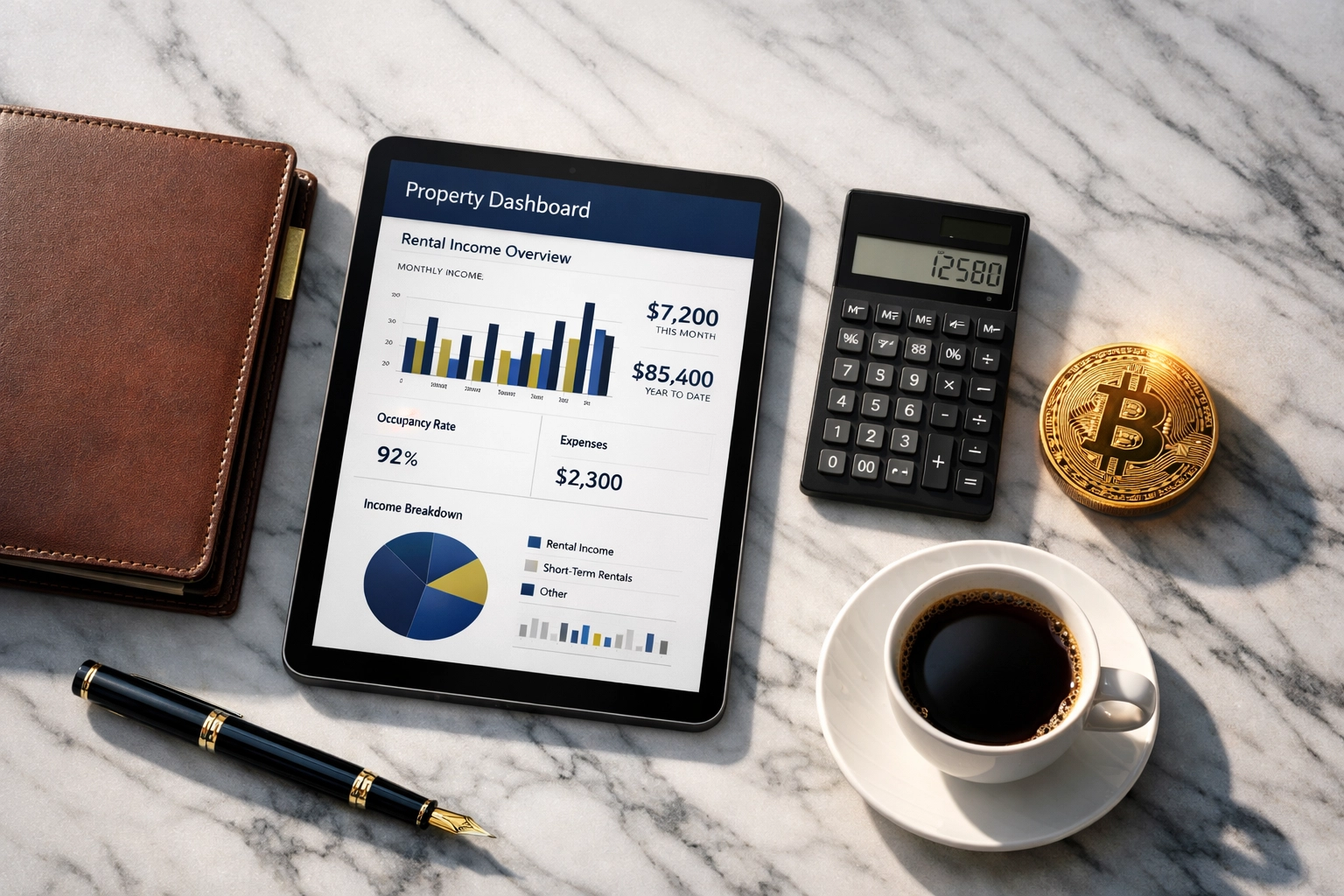
This is where the magic happens. Every dollar of NOI from your real estate automatically converts to Bitcoin purchases.
Set up a systematic process:
Monthly or Quarterly Conversions: As real estate distributions hit your operating account, execute Bitcoin purchases immediately. This is dollar-cost averaging on autopilot.
Fixed Allocation Percentage: Decide upfront what percentage of real estate cash flow goes to Bitcoin. Conservative approach: 50-70%. Aggressive: 80-100%. This isn't money you need to live on: it's capital you're redeploying.
No Market Timing: The whole point is consistency. You buy when Bitcoin is at $100K. You buy when it drops to $40K. You buy through every cycle because your real estate keeps generating cash regardless.
Example: A $6M real estate position generating 8% annual cash flow produces $480K per year. If you allocate 75% to Bitcoin purchases, that's $360K in systematic accumulation annually. Over a decade, you're building serious Bitcoin exposure without touching your principal.
Step 4: Build in the Remaining 10-20% for Tactical Opportunities
You've got $1-2 million left. This is your flexibility layer.
Use it for:
Private equity in crypto infrastructure companies (exchanges, custody providers, mining operations)
Tokenized real estate when compelling opportunities emerge
Other digital assets with institutional-grade fundamentals (Ethereum for smart contract exposure, etc.)
Dry powder for distressed real estate or crypto during market crashes
This portion can be more active, more tactical. It's where you take calculated risks on emerging opportunities.
Step 5: Establish Your Hold Timeline (Minimum 10 Years)

This isn't a trading strategy. You're building a multi-generational wealth vehicle.
Bitcoin's volatility smooths out dramatically over longer timeframes. Four-year cycles are well-documented. A 10-20 year horizon lets you ride through multiple cycles while your real estate continues generating the fuel for accumulation.
The psychological advantage: When Bitcoin drops 60%, you're not panicking because you're not selling. You're actually accumulating more. Your real estate cash flow insulates you from forced liquidation, which is where most crypto investors fail.
Risk Management: What Could Go Wrong
No strategy is bulletproof. Here's what to watch:
Real Estate Market Corrections: Property values can drop 20-30% in severe recessions. Mitigate this through geographic diversification and focusing on essential housing (multifamily) over luxury commercial.
Bitcoin Regulatory Risk: Government policy could change. Diversify custody across jurisdictions if you're concerned. Consider allocation limits: maybe cap Bitcoin at 40% of total portfolio value even as it appreciates.
Liquidity Constraints: Both real estate and Bitcoin can be illiquid during crises. Maintain 6-12 months of living expenses in traditional liquid assets outside this strategy.
Operational Complexity: Managing multiple syndications, custody relationships, and systematic purchases requires infrastructure. Consider working with a multi-family office or specialized asset manager (like Mogul Strategies) if you don't want to DIY this.
Why This Works at the $10M+ Level
Accredited investors have access to institutional-grade real estate deals that retail investors can't touch. Minimum investments, better fee structures, and direct relationships with operators make the cash flow engine viable.
Similarly, institutional custody and OTC trading desks significantly improve your Bitcoin acquisition and security at this scale.
You're building what corporations are building: a treasury model that combines the stability of income-producing real assets with the asymmetric upside of Bitcoin's fixed supply in an increasingly digital world.
The hybrid approach isn't about picking winners between crypto and real estate. It's about making them work together: real estate generating the consistent fuel, Bitcoin providing the exponential growth potential.
Start with the foundation of cash-flowing properties. Layer in systematic Bitcoin accumulation. Give it a decade. That's how you build a portfolio that works in 2026 and beyond.
Comments