How to Integrate Bitcoin With Your Institutional Portfolio (Without the Volatility Headaches)
- Technical Support
.png/v1/fill/w_320,h_320/file.jpg)
- Jan 16
- 5 min read
Bitcoin's wild price swings have kept many institutional investors on the sidelines. And honestly? That hesitation makes sense. Nobody wants to explain a 30% drawdown to their board or clients.
But here's the thing: the conversation has shifted. Major players like BlackRock, Fidelity, and Goldman Sachs are now offering institutional-grade Bitcoin products. The approval of spot Bitcoin ETFs in January 2024 changed the game entirely. And research consistently shows that a small, strategic Bitcoin allocation can actually improve portfolio performance without blowing up your risk metrics.
The key isn't whether to add Bitcoin, it's how to do it smartly. Let's break down the practical approaches that institutional investors are using to capture Bitcoin's upside while keeping volatility in check.
Why Institutions Are Taking Bitcoin Seriously Now
Before we dive into the how, let's address the why. Bitcoin isn't just a speculative bet anymore. It's becoming a legitimate portfolio diversifier.
The math is compelling. Bitcoin has historically shown low correlation with traditional asset classes like equities and bonds. During certain market stress periods, it's acted as a hedge. And over longer time horizons, its risk-adjusted returns have been attractive, even accounting for the stomach-churning dips along the way.
Brazilian institutional investors, including major asset managers like Itaú Asset, have started recommending Bitcoin allocations specifically to protect against currency devaluation. They're not betting the farm. They're making calculated moves to capture what they see as asymmetric upside potential.

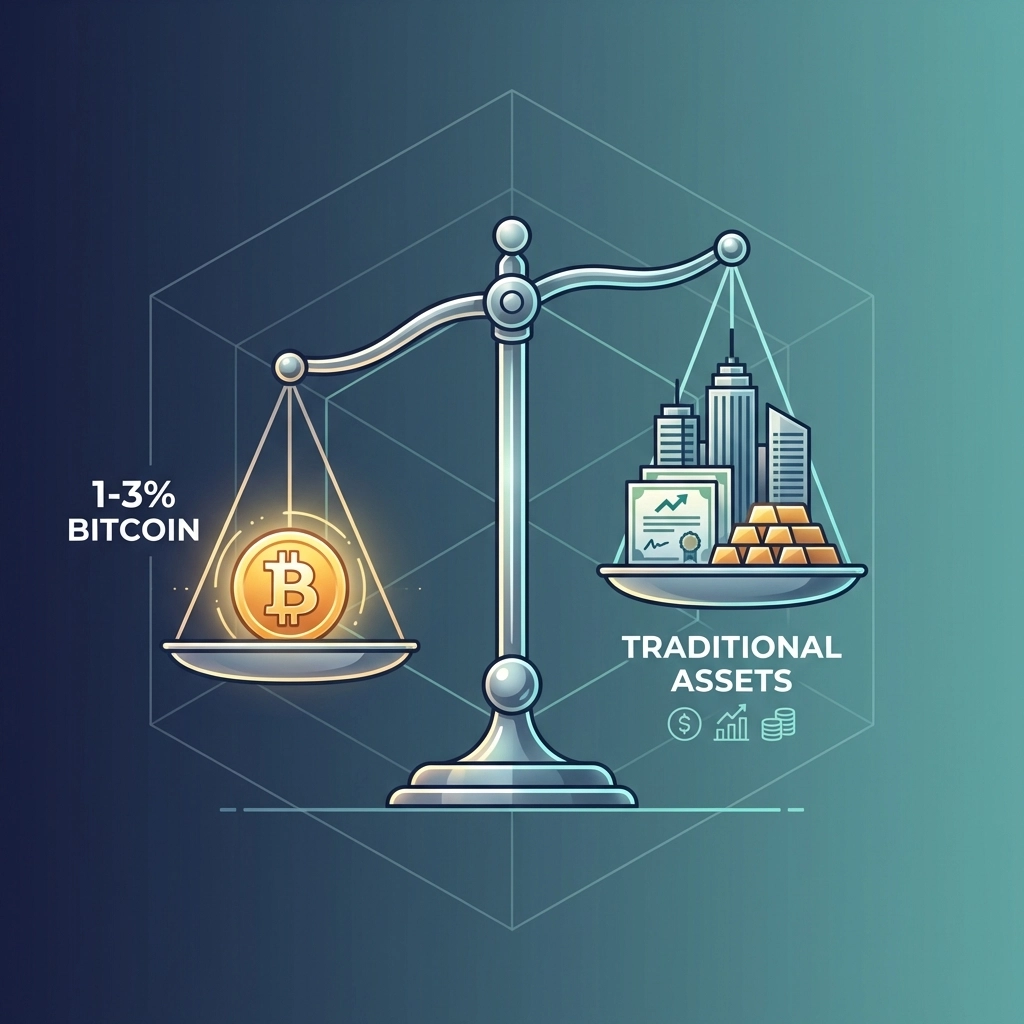
The Magic Number: Why 1-3% Is the Sweet Spot
Here's where most institutions get it wrong. They either go too big (and expose themselves to unnecessary volatility) or they stay at zero (and miss out on meaningful diversification benefits).
Research points to a 1-3% allocation as the optimal range for most institutional portfolios. Why?
The first 1% does the heavy lifting. Studies show that the most impactful diversification benefit comes from that initial small allocation. You get substantial return enhancement with minimal added risk. It's the best bang for your buck.
Beyond 3%, volatility starts to dominate. Yes, larger allocations can improve returns further. But the volatility trade-off becomes less favorable. You're taking on proportionally more risk for diminishing marginal benefit.
Think of it like adding spice to a dish. A little enhances the flavor. Too much overwhelms everything else.
For most institutional mandates, staying in that 1-3% range lets you participate in Bitcoin's potential upside while keeping overall portfolio volatility within acceptable bounds. Your risk management team will thank you.
Strategic Integration Methods That Actually Work
Okay, so you've decided on your allocation size. Now comes the practical question: how do you actually get Bitcoin exposure without creating operational nightmares?
You've got options. And they vary significantly in terms of complexity, cost, and risk profile.
Spot Bitcoin ETFs: The Path of Least Resistance
The January 2024 approval of spot Bitcoin ETFs was a watershed moment. For the first time, institutions could access Bitcoin through a familiar, regulated vehicle.
The pros:
No custody headaches
Regulatory comfort
Easy integration with existing portfolio systems
Liquidity you can count on
The considerations:
Management fees eat into returns
Tracking error (though typically small)
You don't actually hold Bitcoin directly
For many institutions, especially those new to crypto, ETFs offer the cleanest entry point. You get Bitcoin price exposure through a wrapper that your compliance team already understands.
Bitcoin-Backed Yield Strategies
Here's where things get interesting. What if you could hold Bitcoin and generate income from it?
Bitcoin-backed yield strategies transform Bitcoin from a purely speculative asset into income-generating capital. Through regulated lending platforms and arbitrage strategies, institutions can earn yields while maintaining their Bitcoin exposure.
Some market-neutral yield strategies collateralized by Bitcoin are allowing conservative allocators to access attractive returns while hedging price risk. The result? You can potentially exceed traditional fixed-income benchmarks.
This approach is particularly appealing for institutional treasurers who need to justify holding any crypto on their balance sheet. Income generation makes the conversation much easier.
Cryptocurrency Funds
Don't want to pick individual strategies yourself? Specialized crypto asset managers have you covered.
Firms like Grayscale, Pantera Capital, and Galaxy Digital offer diversified exposure with professional management. They handle the complexity: custody, rebalancing, risk management: so you don't have to.
The trade-off is fees and less control. But for institutions without deep crypto expertise in-house, the managed approach can make sense.
Bitcoin Futures
CME Group's Bitcoin futures offer another avenue for institutional exposure. You get price participation without actually holding the underlying asset.
This approach offers flexibility that spot ownership can't match. You can go long or short. You can scale in and out more easily. And the operational burden is lighter since you're dealing with a traditional futures contract.
Risk Management Tactics for the Volatility-Averse
Even with a modest allocation, smart institutions layer additional risk management on top. Here are the tactics that work.

Collar Strategies
A collar combines protective puts (which limit your downside) with covered calls (which cap your upside). The result is a defined return range.
This approach is ideal for long-term holders who want to participate in Bitcoin's growth but can't stomach the full volatility. You're essentially trading unlimited upside potential for downside protection.
For institutions with strict risk mandates, collars can make the difference between "approved" and "rejected" when proposing a Bitcoin allocation.
Dollar-Cost Averaging
Simple but effective. Instead of making a lump-sum allocation, you spread your purchases over time.
Dollar-cost averaging significantly mitigates volatility by smoothing your entry price. You'll buy more when prices are low and less when prices are high. Over time, this disciplined approach reduces the impact of any single price swing.
For institutions making their first Bitcoin allocation, DCA is almost always the right move. It removes the pressure of trying to time the market perfectly.
Derivative-Based Hedging
Beyond collars, institutions can use options and futures to hedge specific scenarios. Worried about a near-term crash? Buy puts. Think volatility will spike? Trade VIX-style products.
The crypto derivatives market has matured significantly. Sophisticated hedging strategies that were impossible five years ago are now accessible through regulated exchanges and prime brokers.
The Infrastructure Is Finally Ready
One reason institutions stayed away from Bitcoin for so long was infrastructure. Custody was sketchy. Trading was fragmented. Regulatory clarity was nonexistent.
That's changed dramatically.
BlackRock, Fidelity, Goldman Sachs, and JPMorgan Chase now provide institutional-grade custody services and trading solutions. These aren't crypto-native startups: they're the same firms institutions already trust with trillions in traditional assets.
This infrastructure build-out has reduced technical barriers and operational risks substantially. The "we can't figure out how to safely hold it" excuse doesn't hold water anymore.
Getting Started: A Practical Framework
Ready to move forward? Here's a simple framework:
Start small. Begin with a 1% allocation and evaluate from there.
Choose your vehicle. ETFs for simplicity, direct holding for control, funds for professional management.
Layer risk management. Use DCA for entry, consider collars for ongoing protection.
Build internal expertise. Even with outsourced solutions, someone on your team needs to understand what you own.
Review and rebalance. Bitcoin's volatility means it can drift from target allocation quickly. Set clear rebalancing triggers.
The institutions that are successfully integrating Bitcoin aren't doing anything exotic. They're applying the same disciplined, risk-aware approach they use for every other asset class.
Bitcoin's volatility isn't going away. But with the right allocation size, integration method, and risk management tactics, it doesn't have to give you headaches either.
Comments