Institutional Alternative Investments in 2026: The Proven Framework for Building Recession-Proof Diversified Portfolios
- Technical Support
.png/v1/fill/w_320,h_320/file.jpg)
- 5 days ago
- 5 min read
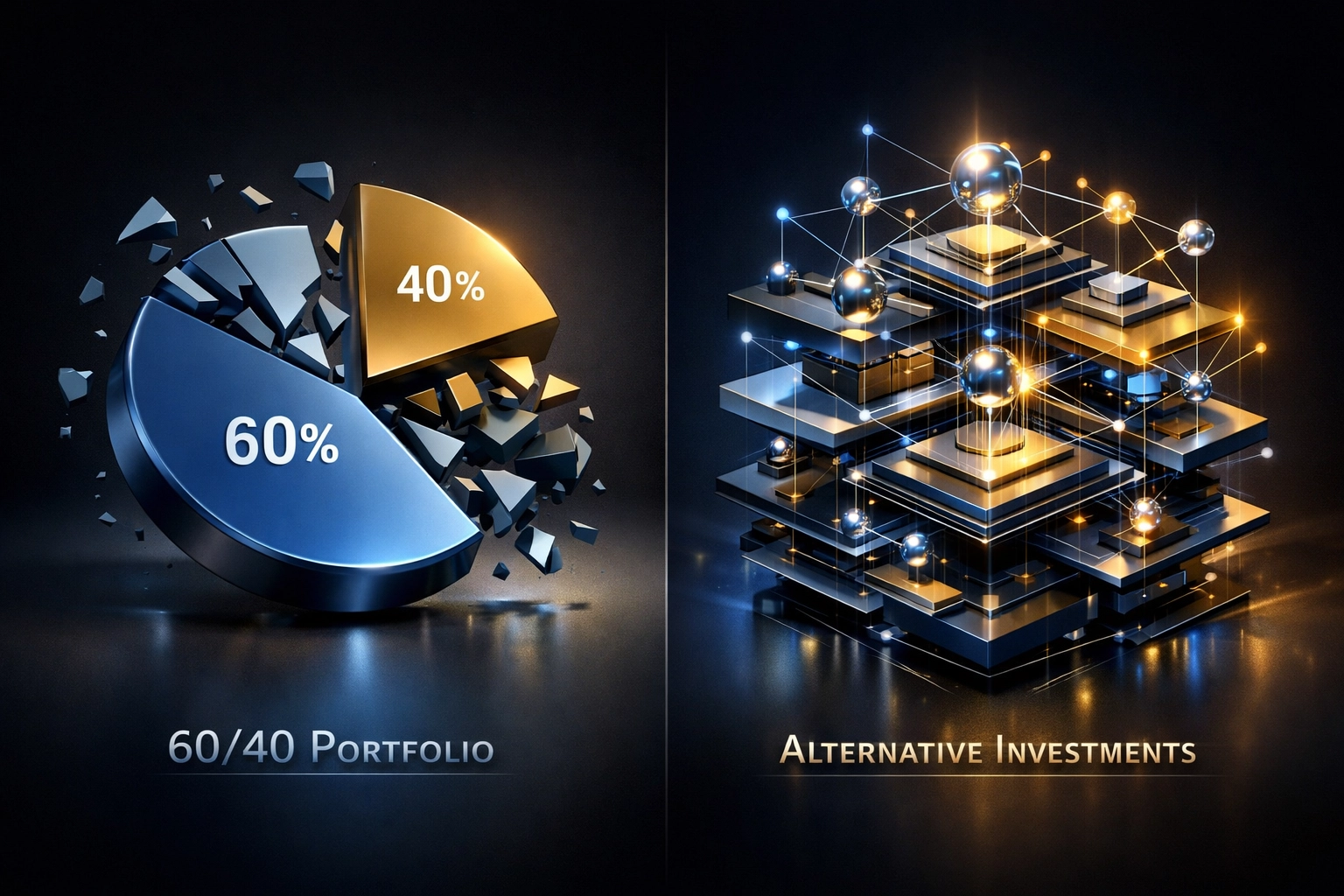
Remember 2022? Both stocks and bonds dropped together, shattering the comfortable illusion that a simple 60/40 portfolio could weather any storm. That wake-up call forced institutional investors to face an uncomfortable truth: traditional diversification isn't enough anymore.
Fast forward to 2026, and the landscape has fundamentally shifted. Alternative assets now represent over $20 trillion globally, with private credit alone exploding from $250 billion in 2007 to $2.8 trillion today. This isn't just a trend: it's a complete reimagining of what sophisticated portfolio construction looks like.
Why Traditional Portfolios Are Failing Institutional Investors
The traditional 60/40 stock-bond split made sense in a world where stocks and bonds reliably moved in opposite directions. That correlation broke down spectacularly, and it's not coming back. Macroeconomic uncertainty, policy volatility, and geopolitical shocks have created an environment where genuine diversification requires looking beyond public markets.
Here's the reality: institutional investors who cling to traditional allocation models are essentially betting that the next recession will look like the last one. That's a dangerous gamble.
The Framework: Building True Portfolio Resilience
At Mogul Strategies, we've developed a framework that moves beyond outdated models. The key is understanding that diversification isn't just about spreading your capital: it's about identifying assets with fundamentally different return drivers.
The most effective institutional portfolios in 2026 are structured around four core alternative pillars: private equity, private credit, infrastructure and real assets, and hedge fund strategies. Let's break down why each matters and how they work together to create genuine recession-proof resilience.
Private Equity: Capitalizing on the 2026 Environment
Private equity has outperformed public equity by 500 basis points annually over the past decade, and 2026 presents particularly compelling conditions. With interest rates normalizing and financing conditions improving, deal activity is accelerating again after a slower period.
The sweet spot right now? Small- and mid-cap private equity. These investments benefit from lower entry valuations and substantial operational improvement opportunities. Unlike large-cap deals that often rely on financial engineering, smaller deals can create value through genuine business transformation.
But here's what most people miss: private equity isn't just about returns. It's about accessing a universe of investments completely uncorrelated with public market gyrations. While the S&P 500 swings with sentiment and Fed pronouncements, your private equity holdings are grinding through operational improvements and market expansion strategies that have nothing to do with daily market noise.

Private Credit: Filling the Gap Banks Left Behind
Private credit represents one of the most significant structural shifts in institutional investing. As banks retreated from middle-market lending due to regulatory constraints, private credit managers stepped in to fill a $2.8 trillion financing gap.
The most attractive segment continues to be sponsor-backed, senior secured direct lending: essentially loans to profitable, growing companies acquired by private equity sponsors. These investments offer compelling total returns relative to public fixed income while maintaining strong structural protections.
What makes private credit particularly valuable in 2026 is its floating-rate nature. Unlike traditional bonds that lose value when rates rise, private credit payments adjust with benchmark rates, providing built-in inflation protection. Plus, the senior secured structure means you're first in line if anything goes wrong.
The catch? Manager selection is absolutely critical here. Scale matters. Sourcing networks matter. Underwriting discipline matters. As the private credit market matures, dispersion among managers is widening dramatically. Choosing the wrong manager can mean the difference between steady, attractive returns and significant losses.
Infrastructure and Real Assets: Riding Secular Trends
Infrastructure investments provide something increasingly rare: predictable cash flows backed by long-term secular trends. We're not talking about speculative bets here: we're talking about the physical and digital backbone of modern economy.
Digital infrastructure, particularly data centers, stands out in 2026. AI-driven capital spending isn't slowing down; if anything, it's accelerating. Every major tech company is racing to build computational capacity, creating sustained demand for data center assets. These investments combine stable cash yields with growth exposure to one of the most powerful technological shifts of our generation.

Beyond digital, traditional infrastructure in healthcare, logistics, and residential sectors continues showing solid fundamentals. These aren't exciting cocktail party conversation starters, but they're exactly what institutional portfolios need: steady, inflation-protected cash flows that keep performing regardless of market sentiment.
Renewable energy infrastructure deserves special mention. Regulatory tailwinds and corporate sustainability commitments are creating decades-long demand visibility. These assets often come with contracted revenue streams extending 15-20 years, providing the kind of predictability that's increasingly hard to find.
Hedge Funds: The Sophistication Multiplier
Hedge funds have gotten a bad rap lately, but that's largely because people evaluate them with the wrong expectations. Hedge funds aren't supposed to match the S&P 500's returns in bull markets: they're supposed to dampen volatility and preserve capital when everything else is falling apart.
The most effective hedge fund strategies for institutional portfolios in 2026 include equity long/short, macro, and multi-strategy approaches. Equity long/short managers can profit from both rising stocks and falling ones, creating genuine market neutrality. Macro funds position portfolios based on global economic trends, currency movements, and policy shifts: perfect for navigating the uncertainty characterizing current markets.
Merger arbitrage deserves attention right now. With M&A activity expected to increase as financing conditions improve, merger arbitrage strategies offer attractive risk-adjusted returns with minimal correlation to equity markets. When a deal is announced, you're essentially betting on its completion rather than market direction.
The Implementation Challenge: Why Manager Selection Matters More Than Ever
Here's the uncomfortable truth about alternative investments: the difference between top-quartile and bottom-quartile managers is massive: often 10-15 percentage points annually in private equity and private credit. In public markets, you can buy an index fund and capture market returns. In alternatives, passive approaches don't exist. Every dollar requires active manager selection.

Rigorous due diligence is non-negotiable. At Mogul Strategies, we evaluate underwriting discipline, track records across full market cycles, team stability, operational capabilities, and alignment of interests. We're looking for managers who can navigate credit cycles, avoid idiosyncratic risks, and deliver consistent performance regardless of market conditions.
Access is another consideration. Historically, top-tier alternative managers were available only to ultra-high-net-worth investors and large institutions. That's changing. Regulatory shifts: including the Department of Labor's recent actions regarding private equity in retirement plans: are democratizing access. Collective investment trusts and registered interval funds are creating structured pathways for a broader range of institutional investors.
Building Your Alternative Portfolio: Practical Next Steps
The Deloitte Center for Financial Services projects alternative funds could grow by more than 50% annually to reach $4.1 trillion by decade's end. This growth reflects a fundamental reality: alternatives are no longer optional for serious institutional portfolios. They're essential.
Start by honestly assessing your current portfolio's exposure to macroeconomic, policy, and geopolitical risks. Are your return drivers genuinely diversified, or are you essentially making multiple bets on the same underlying factors? Map your correlations not just historically but structurally: what drives returns in each holding, and are those drivers truly independent?
From there, build a thoughtful alternative allocation across the four core pillars. Your specific mix will depend on your risk tolerance, liquidity needs, and return objectives, but the framework remains constant: combine private equity's growth potential, private credit's yield and protection, infrastructure's stability and secular trends, and hedge funds' tactical flexibility and downside mitigation.
The Bottom Line
Institutional investing in 2026 requires thinking beyond traditional boundaries. The 60/40 portfolio served us well for decades, but that era is over. Building genuinely recession-proof, diversified portfolios means embracing alternatives not as exotic additions but as core holdings.
The framework is clear: private equity for growth, private credit for yield and structure, infrastructure for stability and secular trends, and hedge funds for tactical positioning. The execution requires expertise, discipline, and access.
At Mogul Strategies, we've spent years developing the frameworks, relationships, and due diligence processes that make alternative investing accessible and effective for institutional investors. The opportunity in 2026 is substantial: for those willing to move beyond outdated models and embrace the future of portfolio construction.
Comments