The 40/30/30 Portfolio Framework: Why Sophisticated Investors Are Making the Switch in 2026
- Technical Support
.png/v1/fill/w_320,h_320/file.jpg)
- Jan 19
- 5 min read
If you've been managing money for any length of time, you've probably heard the 60/40 portfolio preached like gospel. Sixty percent stocks, forty percent bonds. Simple. Elegant. Time-tested.
But here's the thing: what worked for decades is showing serious cracks. And in 2026, more sophisticated investors are asking a simple question, why are we still clinging to a framework built for a different era?
Enter the 40/30/30 portfolio. It's not a radical reinvention. It's an evolution. And for accredited and institutional investors looking to preserve wealth while capturing growth, it might be exactly what your portfolio needs.
Let's break down why this framework is gaining serious momentum.
The 60/40 Portfolio Had a Good Run. It's Over Now.
For the better part of four decades, the 60/40 split delivered. Stocks provided growth. Bonds provided ballast. When equities dropped, fixed income typically rose, smoothing out the ride.
That relationship worked beautifully, until it didn't.
Remember 2022? Both stocks and bonds fell together. The S&P 500 dropped over 18%. The Bloomberg U.S. Aggregate Bond Index fell more than 13%. For investors relying on that negative correlation to protect them, it was a wake-up call.
The culprit? Rising interest rates and persistent inflation created an environment where traditional diversification simply broke down. Stocks and bonds started moving in the same direction, and suddenly that "balanced" portfolio felt a lot less balanced.

Here's the uncomfortable truth: this isn't just a one-time glitch. Many analysts now view positive stock-bond correlation as a structural feature of the current macroeconomic environment. Higher-for-longer rates, geopolitical uncertainty, and inflation volatility have changed the game.
The 60/40 model isn't dead. But for sophisticated investors managing real wealth, it's no longer enough on its own.
What Exactly Is the 40/30/30 Framework?
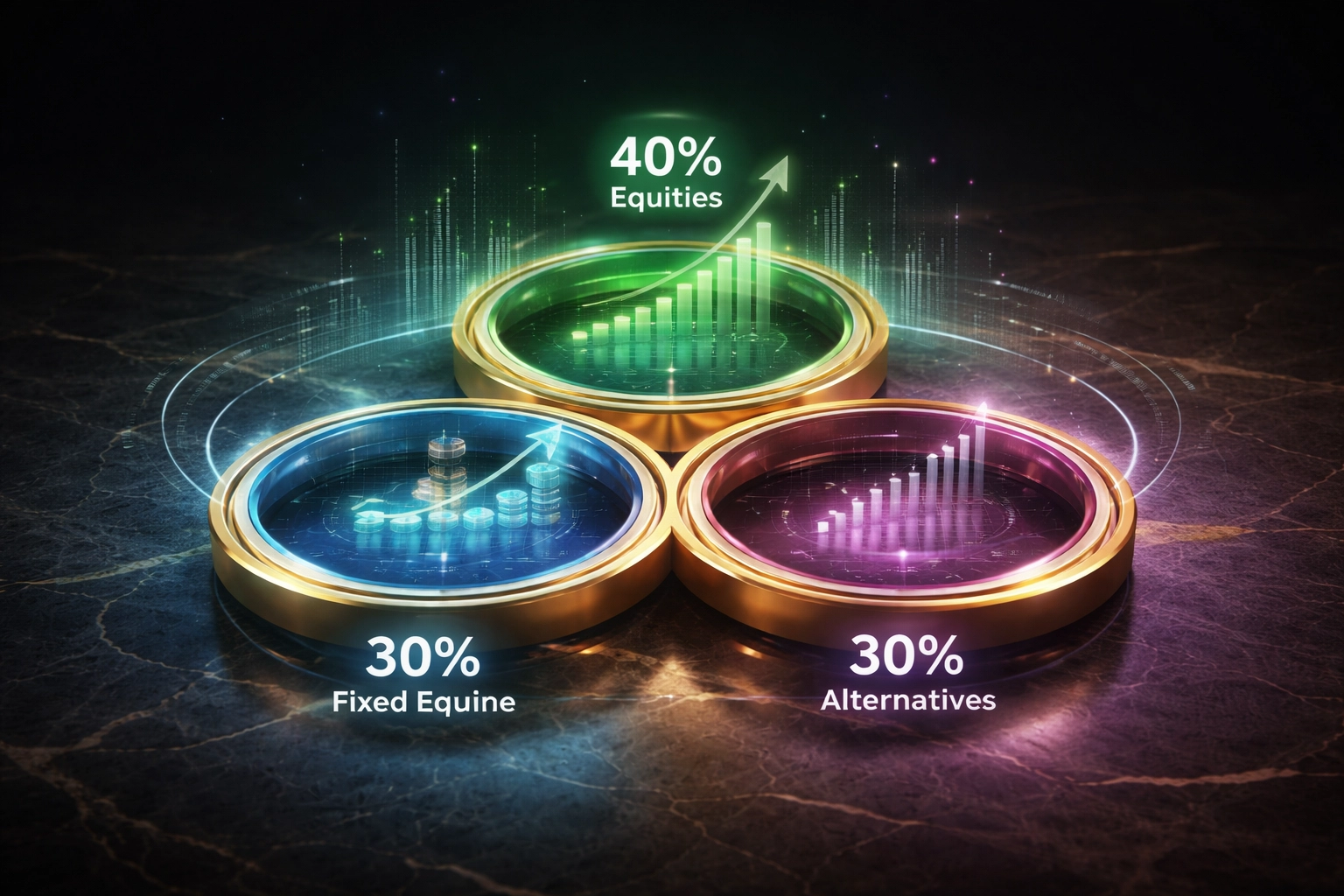
The 40/30/30 portfolio is straightforward in concept:
40% Equities – Your growth engine
30% Fixed Income – Your stability anchor
30% Alternative Investments – Your fortification layer
The math is simple: you're taking 20% from equities and 10% from bonds in a traditional 60/40 setup, and redirecting that capital into alternatives.
But what makes this third sleeve so valuable?
Alternative investments, think private equity, real estate, hedge funds, infrastructure, and yes, even digital assets like Bitcoin: introduce strategies with fundamentally different risk characteristics. They don't rely solely on market direction to generate returns. In theory (and increasingly in practice), they can hold up when traditional assets stumble together.
This third sleeve acts as a "fortification layer" designed to preserve capital during those painful periods when stocks and bonds move in lockstep.
The Numbers Back It Up
Let's talk performance, because that's what ultimately matters.
J.P. Morgan's research found that adding just a 25% allocation to alternative assets can improve traditional 60/40 returns by 60 basis points. That might sound small, but on a projected 7% annual return, that's an 8.5% improvement. Over decades of compounding, those basis points add up to real money.
KKR's analysis went further, finding that the 40/30/30 allocation outperformed 60/40 across all timeframes they studied.
Mercer's quantitative testing of portfolio transitions showed improved client outcomes in every scenario tested when moving from 60/40 to 40/30/30.
Now, here's the nuance that separates sophisticated investors from the rest: raw returns aren't the whole story.
Historical data from November 2001 through August 2025 actually shows the 40/30/30 portfolio slightly underperformed on total returns: 6.89% compound annual growth versus 7.46% for 60/40.
But look at the Sharpe ratio, which measures risk-adjusted returns. The 40/30/30 portfolio scored 0.71 versus 0.56 for the traditional model. That's a significant improvement in return per unit of risk taken.
For investors focused on wealth preservation and sustainable growth: not just chasing the highest number: that risk-adjusted edge matters enormously.
What Goes Into the Alternatives Sleeve?
This is where the 40/30/30 framework gets interesting, and where firms like Mogul Strategies can add real value.
The alternatives sleeve isn't one-size-fits-all. It should be tailored to your goals, risk tolerance, and time horizon. But common components include:
Private Equity
Access to companies before they go public, capturing growth that public market investors never see. Requires longer lock-up periods but historically delivers premium returns.
Real Estate
From direct property ownership to syndications and REITs, real estate offers income, appreciation, and inflation hedging. It's a tangible asset that behaves differently from paper securities.
Hedge Funds
Strategies like long/short equity, global macro, and market-neutral approaches can generate returns regardless of whether markets go up or down. The key is manager selection.
Infrastructure
Toll roads, utilities, data centers: these assets often have contracted cash flows and inflation-linked revenues. Boring? Maybe. Effective? Absolutely.
Digital Assets
Bitcoin and select cryptocurrencies are increasingly finding a place in institutional portfolios. Not as speculation, but as a non-correlated asset with unique monetary properties. Allocation sizes vary, but the conversation has moved from "if" to "how much."

The beauty of the alternatives sleeve is flexibility. You're not locked into one strategy. You can blend these components based on market conditions and your specific situation.
Implementation: What to Consider
Before you restructure your entire portfolio, let's be realistic about the trade-offs.
Higher Fees
Alternative investments typically cost more than index funds or traditional bonds. Private equity funds might charge 2% management fees plus 20% of profits. Hedge funds operate similarly. These costs eat into returns, so manager selection becomes critical.
Reduced Liquidity
Many alternatives lock up your capital for years. Private equity might have a 7-10 year horizon. Real estate syndications often run 5-7 years. If you need access to your money quickly, this matters.
Complexity
Managing a 40/30/30 portfolio requires more oversight than a simple stock/bond split. Due diligence on alternative managers, monitoring performance across asset classes, and rebalancing all demand time and expertise.
Potential Underperformance in Bull Markets
Here's the honest truth: during extended equity bull runs, the 40/30/30 portfolio may lag a pure 60/40 or even an all-equity approach. You're trading some upside potential for downside protection and smoother returns.
For investors with long time horizons and strong stomachs, that trade-off might not make sense. For those prioritizing wealth preservation and consistent risk-adjusted returns, it often does.
Is 40/30/30 Right for You?
This framework isn't for everyone. But it's particularly well-suited for:
High-net-worth individuals focused on multi-generational wealth transfer
Accredited investors who can access private markets
Institutional allocators managing capital with defined risk parameters
Anyone who felt the pain of 2022 and wants better downside protection
The 60/40 portfolio served investors well for a long time. But markets evolve. Correlations shift. What worked yesterday doesn't guarantee success tomorrow.
The 40/30/30 framework represents a thoughtful evolution: not abandonment: of traditional portfolio theory. It acknowledges that the world has changed and adapts accordingly.
At Mogul Strategies, we specialize in helping sophisticated investors build portfolios that blend traditional assets with innovative strategies. The 40/30/30 framework is one tool in that toolkit. The right allocation for you depends on your specific goals, constraints, and convictions.
The question isn't whether to diversify. It's whether your current diversification actually works when you need it most.
Comments