The Proven 40/30/30 Portfolio Framework: How Accredited Investors Are Beating Market Volatility
- Technical Support
.png/v1/fill/w_320,h_320/file.jpg)
- 5 days ago
- 4 min read
Remember 2022? If you're managing serious money, you definitely do. It was the year that broke the traditional playbook.
Stocks dropped. Bonds dropped. And that classic 60/40 portfolio that was supposed to protect you through tough times? It got hammered alongside everything else. For the first time in decades, diversification felt like it didn't work.
That's when smart institutional investors started looking at something different: the 40/30/30 framework.
Why the Old 60/40 Model Is Struggling
For generations, the 60/40 portfolio (60% stocks, 40% bonds) was the gold standard. The logic was simple: when stocks zigged, bonds zagged. You got growth from equities and stability from fixed income.
But something fundamental changed.
When inflation spiked and central banks raised rates aggressively, stocks and bonds started moving together. Both asset classes declined simultaneously, which completely undermined the entire point of diversification. If your hedge moves in the same direction as your risk assets, you don't actually have a hedge.

This wasn't just a blip. It exposed a structural weakness in traditional portfolio construction that had been masked during the low-rate environment of the 2010s.
Enter the 40/30/30 Framework
The 40/30/30 approach rethinks diversification from the ground up:
40% Public Equities – Your growth engine
30% Fixed Income – Your ballast and income generator
30% Alternative Investments – Your real diversifier
The key insight? Adding a third leg to the stool that genuinely moves differently from stocks and bonds. This isn't about chasing returns. It's about building a portfolio that can actually withstand different market environments.
What Goes Into That 30% Alternatives Bucket?
This is where it gets interesting. Alternative investments aren't a single asset class: they're a whole universe of opportunities that most retail investors can't access.
For accredited and institutional investors, this bucket might include:
Private Equity – Direct stakes in private companies with 5-10 year time horizons. These investments aren't marked to market daily, which provides natural volatility dampening.
Real Estate Syndications – Commercial properties, multifamily developments, and income-producing real estate that generates cash flow independent of stock market swings.
Private Credit – Direct lending opportunities that offer attractive yields while being less correlated to public bond markets.
Hedge Funds – Strategies like long/short equity, market neutral, or global macro that can profit in different market conditions.
Digital Assets (Selectively) – For those with appropriate risk tolerance, a small allocation to institutional-grade Bitcoin or crypto strategies can add another layer of diversification.

The magic isn't in any single alternative investment. It's in combining assets that don't all move together when markets get choppy.
The Numbers: Does It Actually Work?
Let's talk performance, because that's what matters.
J.P. Morgan research found that adding a 25% allocation to alternative assets boosted traditional portfolio returns by 60 basis points. That might not sound like much, but on a projected 7% return, that's an 8.5% improvement. Compounded over decades, it's substantial.
KKR went further, testing the 40/30/30 framework across multiple time periods. Their finding? The 40/30/30 consistently outperformed 60/40 across all timeframes studied.
But here's where we need to be honest: the comparison depends on what you're measuring.
Looking at data from November 2001 through August 2025, a 40/30/30 portfolio using U.S. indices actually delivered lower absolute returns: 6.89% compound annual growth versus 7.46% for traditional 60/40.
So why would anyone choose it?
Risk-adjusted returns.
The 40/30/30 framework achieved a Sharpe ratio of 0.71 versus 0.56 for 60/40. In plain English: you got much better returns per unit of risk taken. The ride was smoother, the drawdowns were smaller, and you preserved more capital when markets tanked.
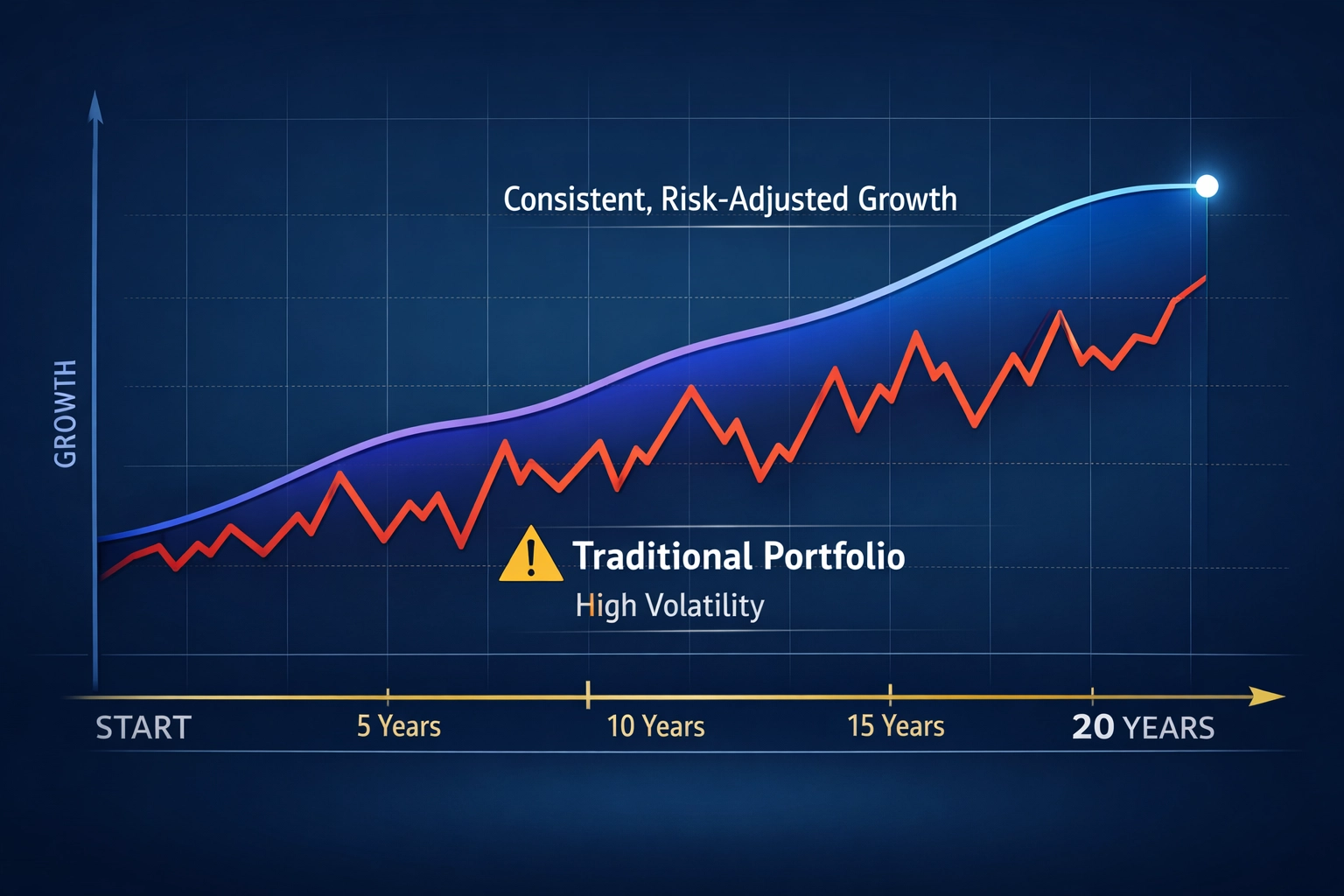
For sophisticated investors, especially those in or near retirement, risk-adjusted performance often matters more than absolute returns. You can't spend volatility, but you can lose decades of gains in a single bad year if you're not properly diversified.
Who Should Consider 40/30/30?
This framework isn't for everyone. Let's be clear about that.
It's designed for accredited investors and institutions who:
Have at least $1-2 million in investable assets (minimum thresholds for most alternative investments)
Can handle illiquidity in part of their portfolio
Understand that alternatives come with higher fees
Prioritize capital preservation alongside growth
Have a long-term investment horizon
If you're a young investor with decades until retirement and a high risk tolerance, you might be better off with more equity exposure. Bull markets reward concentration, and the 40/30/30 framework will likely underperform during strong equity rallies.
But if you're managing family office capital, institutional assets, or personal wealth where preservation matters as much as growth, the framework deserves serious consideration.
Implementation Realities
Theory is one thing. Execution is another.
Building a proper 40/30/30 portfolio requires access to institutional-quality alternative investments. That means:
Due Diligence – Vetting private equity managers, real estate sponsors, and hedge fund strategies takes expertise and time.
Minimum Investments – Many alternatives require $250K to $1M+ per commitment.
Lock-Up Periods – Expect 3-10 year commitments for many private investments.
Higher Fees – Alternatives typically charge 1-2% management fees plus 15-20% performance fees.
Complexity – Tax reporting gets more complicated with K-1s, different valuation schedules, and capital call structures.

This is why most investors working with this framework partner with experienced asset managers who have established relationships with top-tier alternative investment managers. The access and expertise matter as much as the allocation strategy itself.
The Bottom Line
The 40/30/30 framework isn't magic. It's not going to double your returns or eliminate all risk.
What it does offer is a more robust approach to portfolio construction in an environment where stocks and bonds can no longer be relied upon to move independently. By introducing genuine diversification through alternatives, you build a portfolio that can weather different market conditions without depending on any single asset class to bail you out.
The framework has delivered better risk-adjusted returns historically. It preserved capital better during the 2022 downturn. And it provides exposure to return streams that simply aren't available in public markets.
Is it proven? The data suggests it's effective for risk-adjusted performance, though it may lag in absolute returns during sustained bull markets. Is it right for every investor? Absolutely not.
But for accredited investors and institutions looking to build genuinely diversified portfolios that can handle whatever the next decade throws at us, the 40/30/30 framework deserves a serious look.
Market volatility isn't going anywhere. The question is whether your portfolio is built to handle it.
Want to explore how the 40/30/30 framework might work for your specific situation? Visit Mogul Strategies to learn more about our institutional-grade investment approach.
Comments