The Proven 40/30/30 Portfolio Framework: Why Top Wealth Managers Are Rethinking Diversification
- Technical Support
.png/v1/fill/w_320,h_320/file.jpg)
- Jan 17
- 5 min read
Let's be honest: the 60/40 portfolio had a great run. For decades, it was the gold standard of diversification. Allocate 60% to stocks for growth, 40% to bonds for stability, and call it a day. Simple, elegant, and for a long time, remarkably effective.
But here's the thing: the financial world doesn't stand still. And the assumptions that made 60/40 work so well? They've been eroding for years now.
That's why a growing number of top wealth managers are pivoting to something different: the 40/30/30 framework. It's not a radical departure, but it represents a meaningful evolution in how we think about building resilient portfolios for today's market realities.
Let me walk you through why this shift is happening and what it means for sophisticated investors looking to stay ahead.
The Cracks in the 60/40 Foundation
Before we talk about where we're going, let's understand why we're moving.
The 60/40 model was built on a fundamental assumption: stocks and bonds move in opposite directions. When equities tank, bonds rally. This negative correlation creates a natural hedge, smoothing out returns over time.
Except that's not what's been happening lately.

In recent years, we've watched stocks and bonds move almost in tandem. Think about 2022: both asset classes got hammered simultaneously. That's not supposed to happen in the 60/40 playbook.
Several factors are driving this breakdown:
Persistent inflation and rate volatility. When inflation runs hot and central banks respond aggressively, both stocks and bonds can suffer together. The traditional diversification benefit simply evaporates.
Elevated interest rates. We've moved out of the near-zero rate environment that propped up both asset classes for over a decade. That changes the math considerably.
Geopolitical uncertainty. From supply chain disruptions to regional conflicts, market shocks are becoming more frequent. A two-asset-class approach struggles to absorb these hits.
The bottom line? The correlation between stocks and bonds is likely to remain problematic in this new macroeconomic regime. Waiting for a return to "normal" could be a costly strategy.
Enter the 40/30/30 Framework
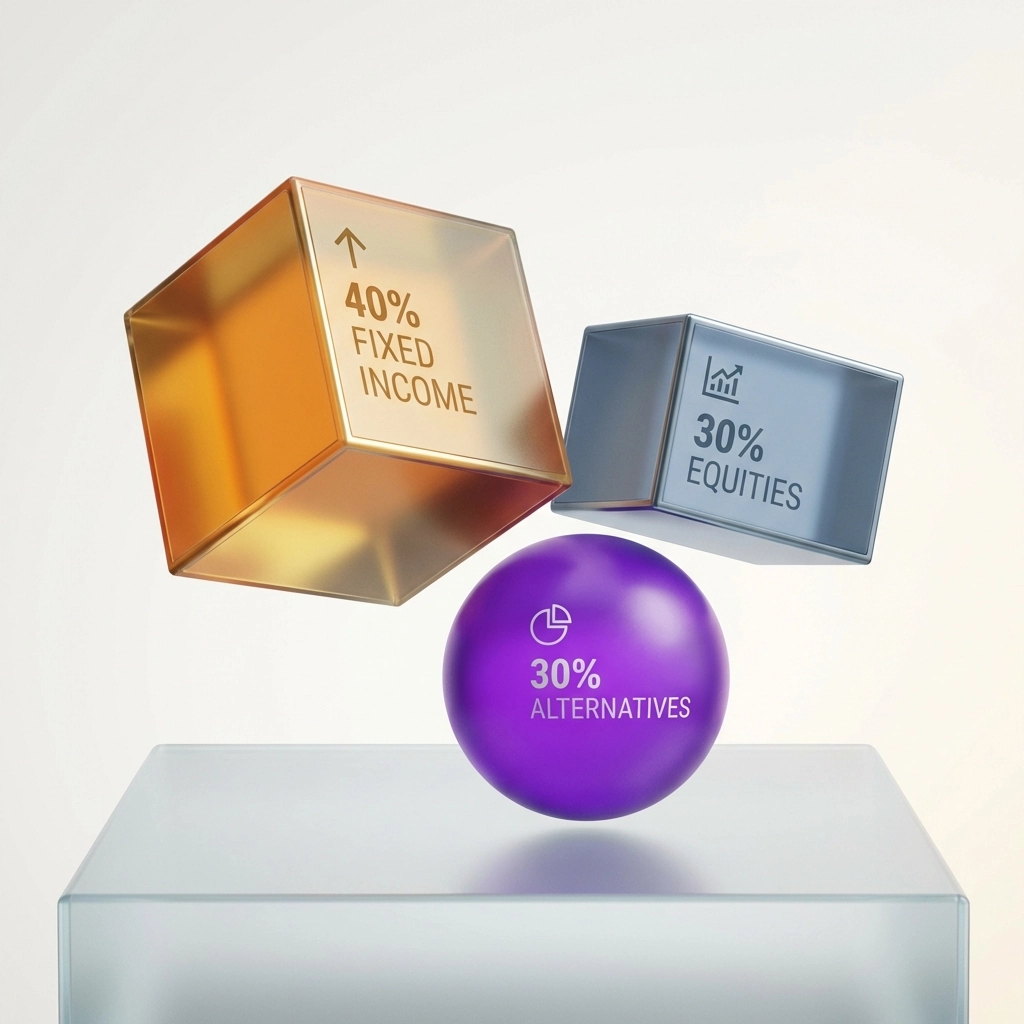
The 40/30/30 model takes a different approach to portfolio construction:
40% Public Equities – Still your primary growth engine
30% Fixed Income – Reduced but still present for income and some stability
30% Alternative Investments – The new diversification layer
This isn't about abandoning traditional assets. It's about acknowledging that two asset classes aren't enough to navigate today's complexity. That third sleeve: alternatives: provides the diversification that bonds used to deliver.
And the results speak for themselves.
Research shows that the 40/30/30 portfolio delivers a 40% improvement in its Sharpe ratio compared to traditional approaches. For those keeping score at home, the Sharpe ratio measures risk-adjusted returns: essentially, how much return you're getting for the risk you're taking. A 40% improvement is significant.
J.P. Morgan found that adding even a 25% allocation to alternatives can boost portfolio returns by 60 basis points. On a projected 7% return, that's an 8.5% improvement. Not bad for a structural change.
Perhaps most telling, research from KKR confirmed that 40/30/30 outperformed 60/40 across all timeframes studied. Not some timeframes. All of them.
The Alternative Sleeve: More Than Just "Other Stuff"
Here's where it gets interesting. The 30% alternative allocation isn't a random grab bag of non-traditional investments. Done right, it's a strategically constructed sleeve that serves specific functions within your portfolio.
Think of alternatives as falling into three categories:
Downside Protection
These are strategies designed to cushion losses during market stress. When everything else is selling off, these positions help limit the damage. They're your portfolio's insurance policy: you hope you don't need them, but you're grateful when you do.
Uncorrelated Return Generators
These strategies have lower sensitivity to traditional market movements. They zig when stocks and bonds zag. This is the true diversification that bonds used to provide but increasingly can't.
Upside Amplifiers
Private equity, 130-30 funds, and similar strategies that capture growth potential beyond what public markets offer. These are your return enhancers: they won't smooth out volatility, but they can meaningfully boost long-term performance.

The beauty of this functional approach is flexibility. Rather than maintaining static allocations, you can dynamically rebalance according to macroeconomic conditions. Expecting a downturn? Lean into protection. Bull market ahead? Shift toward amplifiers.
This dynamic capability improves returns, reduces risk, and controls drawdowns more effectively than a set-it-and-forget-it allocation ever could.
From Institutional Advantage to Individual Access
For decades, institutional investors have known what many individual investors are just discovering. Endowments, pension funds, and sovereign wealth funds have allocated 40% or more to alternatives for years. They understood that diversification requires more than two asset classes.
The challenge was access. Many of the best alternative strategies required institutional-scale capital, locking out everyone else.
That's changing rapidly.
New investment vehicles are making institutional-quality strategies available to accredited investors and high-net-worth individuals. The 40/30/30 framework essentially democratizes the resilience that institutions have enjoyed for decades.
For advisors and portfolio managers, this means greater certainty on client goals. By reducing concentrated exposure to equity and industry risk, you're providing multiple layers of portfolio fortification. That's a meaningful shift in what you can deliver.
Practical Implementation Considerations
Adopting 40/30/30 isn't just about shifting numbers on a spreadsheet. There are real considerations to work through:
Liquidity management. Many alternative investments have longer lockup periods than public securities. Your portfolio construction needs to account for this, ensuring you maintain adequate liquidity for client needs.
Due diligence requirements. Not all alternatives are created equal. Manager selection matters enormously. A hedge fund or private equity allocation is only as good as the underlying strategy and execution.
Fee awareness. Alternative investments typically carry higher fees than passive index funds. That's fine if the returns and diversification benefits justify the cost: but you need to evaluate this honestly.
Complexity tolerance. Some clients want to understand every position in their portfolio. Others are outcome-focused and don't care about the details. Know your audience.

Where Digital Assets Fit In
We'd be remiss not to mention the evolution happening within the alternatives category itself. Institutional-grade digital asset strategies are increasingly finding a place within that 30% sleeve.
Bitcoin and select cryptocurrencies, when integrated thoughtfully, can serve as both uncorrelated return generators and potential upside amplifiers. The key word is "institutional-grade": this isn't about speculative retail trading. It's about strategic allocation within a risk-managed framework.
At Mogul Strategies, we believe blending traditional alternative assets with innovative digital strategies creates a more robust portfolio than either approach alone. But that's a topic for another post.
The Path Forward
The 40/30/30 framework isn't about chasing the latest investment fad. It's about recognizing that market conditions have changed and portfolio construction needs to evolve accordingly.
The correlation between stocks and bonds has shifted. Inflation and rate dynamics are different than they were. Geopolitical risks are more pronounced. In this environment, relying on a two-asset-class model is increasingly difficult to justify.
The institutions figured this out years ago. Now the rest of us are catching up.
Whether you're managing capital for clients or building your own wealth, the question isn't whether to consider alternatives. It's how to integrate them effectively within a coherent framework.
The 40/30/30 model provides that framework. The performance data supports it. And the structural market changes make it increasingly necessary.
The 60/40 portfolio had its moment. For what comes next, you'll want a different playbook.
Comments