The 40/30/30 Diversified Portfolio Framework: Long-Term Wealth Preservation for Institutional Investors
- Technical Support
.png/v1/fill/w_320,h_320/file.jpg)
- 7 days ago
- 5 min read
Look, if you're still running a traditional 60/40 portfolio in 2026, we need to talk.
The investment world has changed. The old playbook, 60% stocks, 40% bonds, worked beautifully for decades. But here's the problem: when stocks tank, bonds don't cushion the fall like they used to. They're increasingly moving in the same direction, which defeats the whole point of diversification.
That's where the 40/30/30 framework comes in. It's not some radical new theory. It's actually what major institutions have been doing for years, just packaged in a way that makes sense for sophisticated investors who want better results without unnecessary complexity.
What Is the 40/30/30 Portfolio Framework?
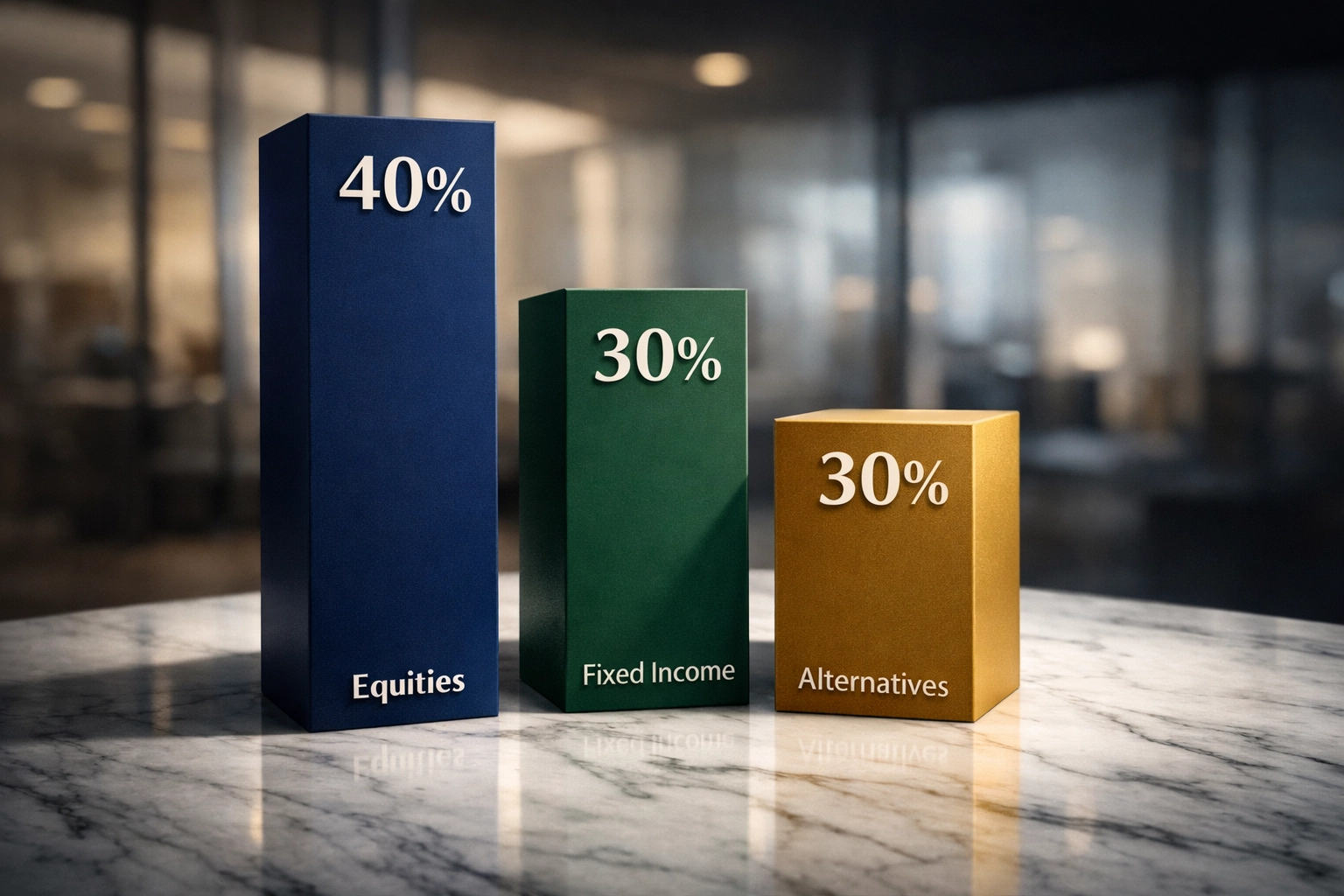
Simple breakdown: 40% public equities, 30% fixed income, 30% alternative investments.
The magic is in that 30% alternatives allocation. This isn't just about adding Bitcoin or throwing money at private equity because it sounds fancy. It's about deliberately reducing your correlation to traditional markets and building multiple layers of protection.
Think of it this way: if your portfolio only has two engines (stocks and bonds), and both start sputtering at the same time, you're in trouble. The 40/30/30 model gives you a third engine that runs on completely different fuel.
Why Traditional Diversification Is Breaking Down
For years, the 60/40 model worked because stocks and bonds moved independently. When equities dropped, bonds typically rallied. That negative correlation was your safety net.
But that relationship has fundamentally shifted. Rising interest rates hurt bond prices. Inflation concerns hit both stocks and bonds simultaneously. Geopolitical uncertainty? It rattles everything at once.
Institutional investors figured this out early. They've been allocating over 40% to alternatives for years. Now, that same strategy is accessible to accredited investors who understand the trade-offs.
Breaking Down the 30% Alternatives Sleeve
This is where it gets interesting. That 30% allocation isn't a monolith, it's a diversified mix of non-correlated assets designed to behave differently than stocks and bonds.
Private Equity and Private Credit
These illiquid investments offer a different return profile than public markets. Yes, you're locking up capital. But that illiquidity premium exists for a reason: you're getting paid to be patient. Private credit, especially in today's environment, can generate consistent income streams that aren't directly tied to stock market volatility.
Real Estate and Infrastructure
We're not talking about flipping houses. Think essential infrastructure: cell towers, ports, pipelines, renewable energy projects. These assets often have inflation adjustment clauses built into their contracts. When consumer prices rise, your returns adjust accordingly. That's a natural hedge most traditional portfolios lack.

Strategic Hedge Fund Allocations
Long-short strategies, market-neutral approaches, tactical trading: these tools help smooth out returns across different market cycles. They're not designed to hit home runs. They're designed to generate positive returns regardless of whether the broader market is up or down.
The key is combining these alternatives in a way that reduces overall portfolio correlation while maintaining reasonable liquidity and return expectations.
The Wealth Preservation Advantage
Here's what the data shows: J.P. Morgan research found that adding just 25% alternatives to a 60/40 portfolio improved returns by 60 basis points. That's an 8.5% improvement in performance. Mercer's modeling showed that wealth managers transitioning from 60/40 to 40/30/30 saw improved client outcomes across multiple scenarios.
But it's not just about returns. It's about resilience.
Risk Reduction Through Real Diversification
By reducing your equity allocation from 60% to 40%, you're immediately cutting your exposure to equity market crashes. But you're not sacrificing growth potential: you're redistributing it across assets that don't all move together. That's what real diversification looks like.
Inflation Protection That Actually Works
When inflation spikes, traditional portfolios suffer. Bonds get crushed because their fixed payments lose purchasing power. Stocks often struggle as input costs rise and consumers pull back spending.
Alternative assets with built-in inflation adjustments don't have this problem. Infrastructure assets with inflation-linked revenue streams actually benefit from rising prices. Real estate rents adjust upward. Private debt with floating rate structures capture higher yields.

Predictable Income Streams
The relative illiquidity of private assets isn't a bug: it's a feature. Because these investments aren't marked to market daily, they enable patient, long-term strategic management. You're not reacting to every market fluctuation. You're building predictable income streams that compound over time.
Who Should Consider the 40/30/30 Framework?
This isn't for everyone. Let's be clear about that.
If you need immediate liquidity for all your capital, this framework won't work. That 30% alternatives allocation typically involves multi-year lock-ups. You need to be comfortable with that illiquidity premium.
If you're just starting to build wealth and have less than $1 million in investable assets, you're probably better off with simpler strategies. Build your foundation first.
But if you're an accredited investor, family office, or institutional allocator looking to preserve multi-generational wealth? This framework is worth serious consideration.
You understand that volatility isn't the same as risk. You have the capital base to access institutional-quality alternative investments. And you're thinking in decades, not quarters.
Implementation Considerations
Moving from a traditional portfolio to a 40/30/30 allocation isn't something you do overnight. It requires thoughtful planning, proper due diligence on alternative managers, and realistic expectations about liquidity profiles.
Manager Selection Matters
Not all private equity funds are created equal. Not all real estate syndications deliver. The quality of your alternative investment managers will make or break this strategy. Look for proven track records, aligned incentives, and transparent fee structures.
Gradual Transition Strategy
You don't have to flip your entire portfolio in one day. Many sophisticated investors take a phased approach, gradually building their alternatives allocation over 2-3 years as they identify the right opportunities and managers.
Ongoing Rebalancing
Because alternatives aren't liquid, rebalancing becomes more complex. You need to think ahead about distributions, capital calls, and how new capital gets allocated across the framework.

The Bigger Picture
The 40/30/30 framework isn't about chasing returns. It's about building a more resilient portfolio that can withstand multiple types of market stress while still achieving meaningful long-term growth.
It acknowledges that the investment landscape has evolved. Correlation patterns have shifted. Traditional diversification tools aren't as effective as they once were. And institutional-quality alternatives are now accessible to sophisticated investors who previously couldn't access them.
At Mogul Strategies, we've seen firsthand how this framework helps investors navigate uncertain markets while maintaining their long-term wealth preservation goals. It's not about complexity for its own sake: it's about deliberately constructing a portfolio with multiple layers of fortification.
The traditional 60/40 model had its time. For many investors, that time has passed. The question isn't whether to evolve your portfolio strategy: it's how quickly you're willing to adapt to the new reality.
If you're ready to explore what a properly constructed 40/30/30 allocation could look like for your specific situation, let's talk. We build these frameworks every day for investors who demand better risk-adjusted returns and genuine diversification.
Because in 2026, preservation isn't passive. It's strategic.
Comments