The 40/30/30 Portfolio Framework: How Accredited Investors Are Beating Market Volatility
- Technical Support
.png/v1/fill/w_320,h_320/file.jpg)
- 10 hours ago
- 5 min read
The traditional 60/40 portfolio just had its worst year in decades. Stocks dropped. Bonds dropped. Everything moved in the same direction at the same time.
If you're an accredited investor watching your "diversified" portfolio behave like a single asset during a downturn, you're not alone. The correlation problem has finally caught up with conventional wisdom, and smart money is moving to a different model entirely.
Enter the 40/30/30 framework: a portfolio structure that's helping institutional investors and high-net-worth individuals navigate volatility with better risk-adjusted returns. Here's what's actually working right now.
What Is the 40/30/30 Portfolio Framework?
The 40/30/30 model is straightforward:
40% equities for growth exposure
30% fixed income for stability and income
30% alternatives for non-correlated returns
This isn't just a reshuffling of the same old asset classes. It's a fundamental rethinking of how diversification actually works when traditional markets move together.
The framework originated from institutional investors who've allocated to alternatives for decades. What's changed is the accessibility. Accredited investors now have access to the same alternative strategies that endowments and pension funds have used to outperform for years.

Why 60/40 Stopped Working
The 60/40 portfolio was built for a different era: one where stocks and bonds reliably moved in opposite directions. When equities dropped, bonds rallied, cushioning the blow.
That relationship broke down spectacularly in 2022 when inflation spiked and central banks tightened policy. Both stocks and bonds fell simultaneously, leaving investors with nowhere to hide.
The problem isn't temporary. Rising interest rates and inflationary pressures create environments where the stock-bond correlation shifts positive. Your "balanced" portfolio becomes unbalanced exactly when you need diversification most.
The 40/30/30 framework addresses this by reducing exposure to both equity risk and interest rate risk, then filling that space with assets that move independently of traditional markets.
Breaking Down the Allocation
The 40% Equity Stake
You still need growth. Equities remain the primary engine for wealth accumulation over time. The 40% allocation maintains meaningful exposure to global markets while leaving room for protection on the downside.
This can include domestic and international stocks, with potential tilts toward factors like value, quality, or momentum depending on your outlook. The key is reducing the concentration risk that comes with a 60% equity position.
The 30% Fixed Income Component
Bonds still matter, but their role has evolved. At 30%, fixed income provides ballast without overexposure to interest rate risk.
This allocation works best with a ladder of maturities, a mix of credit qualities, and potentially some inflation-protected securities. The goal isn't to maximize yield: it's to provide liquidity and stability when you need to rebalance or cover distributions.
The 30% Alternatives Bucket
This is where the framework gets interesting. The alternatives allocation is designed to do what traditional assets can't: generate returns that don't depend on stock market direction or interest rate movements.
Alternative investments can include:
Private equity and venture capital for long-term growth outside public markets
Real estate through direct ownership or syndications for income and appreciation
Commodities as an inflation hedge with low correlation to financial assets
Market-neutral strategies that profit from pricing inefficiencies regardless of market direction
Hedge funds using long/short, event-driven, or macro strategies
Digital assets like Bitcoin for portfolio diversification and asymmetric return potential

The alternatives component isn't just about diversification: it's about accessing return streams that institutions have exploited for years while retail investors stayed locked into publicly traded securities.
The Performance Advantage
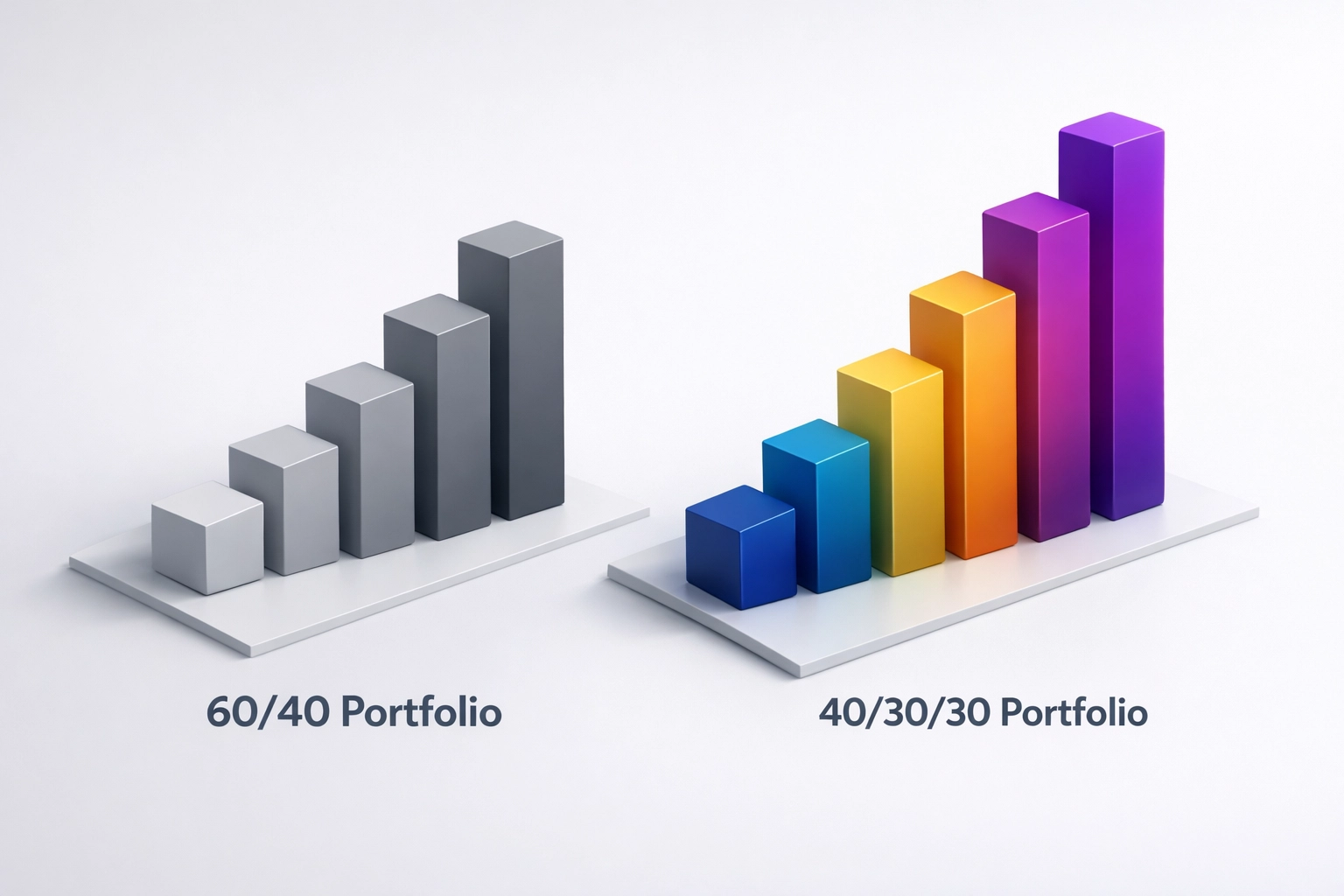
The numbers back up the framework. Research comparing 40/30/30 portfolios to traditional 60/40 allocations from November 2001 through August 2025 shows compelling results:
Sharpe ratio of 0.71 for 40/30/30 versus 0.56 for 60/40: a 40% improvement in risk-adjusted returns
Better downside protection during market drawdowns
More consistent performance across different market environments
J.P. Morgan's analysis found that adding just a 25% alternatives allocation to a traditional portfolio can boost returns by 60 basis points: an 8.5% improvement to projected returns. The 40/30/30 framework takes this further with a full 30% allocation.
The real benefit shows up during volatility. When stocks and bonds both struggle, the alternatives bucket provides stability and sometimes even gains, rebalancing opportunities, and dry powder for deployment when assets go on sale.
Why Alternatives Make the Difference
The alternatives allocation solves the correlation problem. Unlike stocks and bonds that increasingly move together during stress periods, true alternatives follow different drivers:
Private equity valuations aren't marked to market daily
Real estate values depend on fundamentals like rental income and supply/demand
Commodities react to inflation and global trade flows
Market-neutral strategies explicitly target zero correlation to equity markets
Bitcoin and digital assets operate on adoption curves independent of traditional finance

This non-correlation is the secret weapon. When your equity allocation drops 20%, having 30% of your portfolio in assets that don't care about stock market movements dramatically reduces overall volatility.
Implementation Considerations
Building a 40/30/30 portfolio requires more sophistication than buying a few ETFs. Here's what matters:
Access to quality alternatives. Not all alternative investments are created equal. Accredited investor status opens doors to private placements, hedge funds, and institutional strategies unavailable to retail investors. Manager selection becomes critical.
Liquidity management. Many alternatives have lock-up periods or limited redemption windows. You need to structure your alternatives bucket with appropriate liquidity for your needs, mixing liquid alternatives with less liquid strategies offering higher return potential.
Fee structures. Alternatives typically carry higher fees than passive index funds. The question isn't whether fees exist: it's whether the risk-adjusted returns after fees justify the allocation. In most institutional portfolios, they do.
Rebalancing discipline. The framework requires periodic rebalancing as asset classes perform differently. This selling high and buying low is where a lot of the advantage comes from, but it takes discipline to execute when markets are volatile.
Tax optimization. With more moving parts, tax efficiency becomes more complex and more important. Strategic asset location, tax-loss harvesting, and qualified opportunity zones all play a role.
Who This Framework Is For
The 40/30/30 portfolio isn't for everyone. It's designed for accredited investors and institutions who:
Have at least $1-2 million in investable assets
Can meet the liquidity requirements of alternative investments
Want institutional-grade diversification
Understand that performance comes from risk management, not just returns
Have the patience for strategies that may underperform during strong bull markets but outperform over full market cycles
If you're still in accumulation mode with a long time horizon and can handle volatility, a more aggressive equity allocation might make sense. But if you're managing significant wealth and need to preserve capital while generating returns, the framework offers a proven path.
Building Your 40/30/30 Portfolio
The framework is a starting point, not a rigid formula. Your specific allocation within each bucket should reflect your risk tolerance, time horizon, liquidity needs, and market outlook.
Some investors tilt more heavily toward private equity within alternatives. Others emphasize real estate or add meaningful digital asset exposure. The key is maintaining the overall structure while customizing the implementation.
At Mogul Strategies, we've built portfolios around this framework that blend traditional institutional strategies with innovative approaches including Bitcoin integration. The goal is always the same: better risk-adjusted returns through true diversification.
The era of simple 60/40 portfolios is over. Market correlations have shifted, and successful investing now requires a more sophisticated approach. The 40/30/30 framework offers a time-tested structure that's helping accredited investors navigate volatility and build wealth with better downside protection.
If your current portfolio still looks like something built for 2010, it might be time to rethink your allocation. The markets have changed. Your portfolio should too.
Comments