The Proven 40/30/30 Framework: How Accredited Investors Balance Traditional Assets with Digital Diversification
- Technical Support
.png/v1/fill/w_320,h_320/file.jpg)
- Jan 30
- 5 min read
The traditional 60/40 portfolio: 60% stocks, 40% bonds: used to be the gold standard for balanced investing. But let's be honest: it's not 2010 anymore. When stocks and bonds move in lockstep during market stress, that diversification you thought you had? It evaporates right when you need it most.
That's where the 40/30/30 framework comes in. It's not revolutionary, but it is practical: and it's gaining serious traction among accredited investors who understand that modern portfolios need modern solutions.
Why the Old Model Is Broken
The 60/40 portfolio worked brilliantly for decades because stocks and bonds typically moved in opposite directions. When equities tanked, bonds provided a cushion. When stocks soared, bonds provided stability. Simple, effective diversification.
But correlations have shifted. Today, we're seeing stocks and bonds decline simultaneously more frequently than historical patterns would suggest. Add inflation into the mix, and suddenly that bond allocation isn't just failing to protect: it's actively losing purchasing power.
Accredited investors have caught on. They're not abandoning traditional assets entirely, but they're definitely rethinking the allocation.

Breaking Down the 40/30/30 Framework
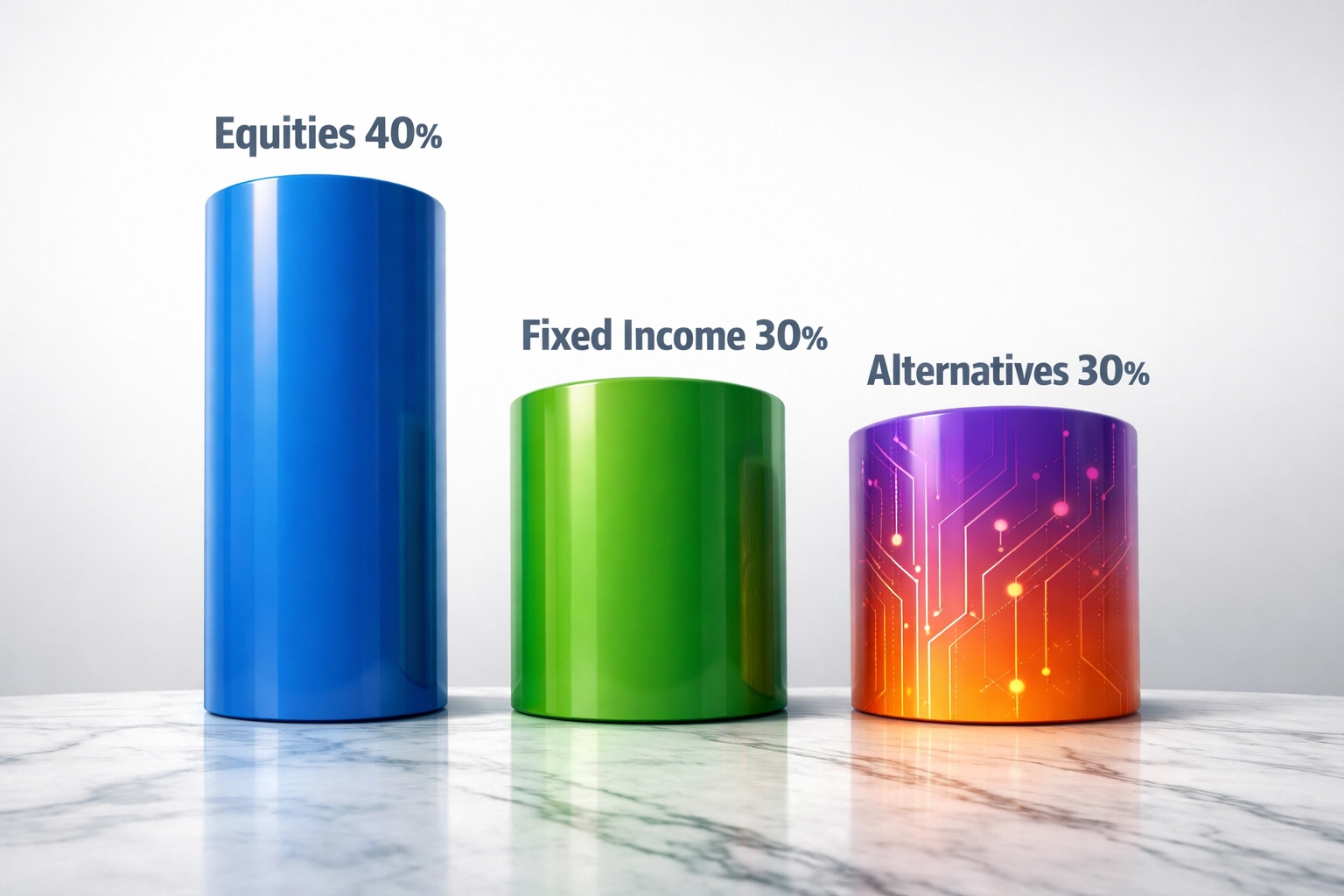
The framework is straightforward:
40% Public Equities – Your growth engine, but scaled back from the traditional 60%
30% Fixed Income – Stability and income, reduced from the traditional 40%
30% Alternative Investments – The diversification powerhouse
That 30% alternatives sleeve is where things get interesting. By pulling 20% from equities and 10% from bonds, you're creating space for assets that don't dance to the same beat as public markets.
The Two Types of Alternatives: Enhancers and Diversifiers
Not all alternatives are created equal. The 30% allocation typically splits between two distinct categories:
Enhancers are alternative strategies that still correlate with traditional markets but offer unique advantages. Think private equity, real estate funds, or hedge fund strategies that amplify returns or mitigate specific risks. They're tied to traditional assets but provide access to opportunities you can't get in public markets: illiquidity premiums, operational improvements, or sophisticated trading strategies.
Diversifiers are where digital assets enter the picture. These are strategies with low-to-zero correlation to traditional markets. Historically, this meant commodities, managed futures, or market-neutral strategies. Today, it increasingly includes digital assets like Bitcoin and other institutional-grade cryptocurrencies.
Where Digital Diversification Fits
Here's what many investors miss: Bitcoin and select digital assets aren't replacing stocks or bonds: they're expanding the alternatives bucket with genuinely uncorrelated return streams.
Bitcoin has shown periods of low correlation to both equities and bonds, particularly over longer time horizons. While it's volatile (no argument there), that volatility in a properly sized allocation can actually improve portfolio efficiency. A 5-10% allocation within that 30% alternatives sleeve means you're talking about 1.5-3% of total portfolio exposure: meaningful but manageable.
The key is treating digital assets as what they are: alternative investments requiring the same due diligence, custody considerations, and risk management as any other alternative strategy. That means institutional-grade custody solutions, regulatory clarity, and integration with your overall portfolio risk parameters.
For accredited investors, this isn't about speculation. It's about accessing an asset class with distinct characteristics:
Limited supply (Bitcoin's 21 million cap)
24/7 global liquidity
Non-sovereign store of value properties
Increasing institutional adoption and infrastructure
The Performance Case
The numbers back this up. Research from J.P. Morgan suggests that adding a 25% allocation to alternative assets can improve 60/40 returns by approximately 60 basis points: translating to an 8.5% improvement on a projected 7% return. That's not marginal; that's material.
KKR's analysis found that 40/30/30 portfolios outperformed traditional 60/40 portfolios across all studied timeframes. The reason? Multiple sources of return and risk mitigation working simultaneously.

When you reduce concentrated equity risk and add genuinely diverse return streams: including digital assets with distinct drivers: you're building a portfolio with better breadth. That breadth matters during drawdowns, during inflation surprises, and during those frustrating periods when traditional assets move together.
Practical Implementation for Accredited Investors
Moving to a 40/30/30 framework isn't about gutting your portfolio overnight. It's a deliberate reallocation that requires:
1. Assessment of Current Holdings Start by mapping your existing alternatives exposure. Many investors already have more alternatives than they realize: real estate, private equity funds, hedge fund allocations. The question becomes whether those alternatives provide true diversification or just private market versions of public equity risk.
2. Identifying True Diversifiers This is where digital assets become compelling. If your alternatives are all real estate and private equity, you're still heavily exposed to economic cycles. Adding Bitcoin or other vetted digital assets can provide orthogonal risk exposure.
3. Infrastructure and Access Accredited investors have advantages here: access to funds, SPVs, and direct investment opportunities not available to retail. For digital assets, this means institutional custody, tax-efficient structures, and proper documentation.
4. Rebalancing Discipline The framework works when you maintain it. That 30% alternatives allocation will drift: especially if digital assets appreciate significantly. Regular rebalancing ensures you're taking profits from outperformers and maintaining your intended risk profile.

Risk Considerations
Let's be clear: the 40/30/30 framework doesn't eliminate risk: it redistributes it. You're trading some upside equity participation for reduced drawdown risk and better diversification. During raging bull markets in stocks, a 40/30/30 portfolio will likely underperform a 60/40. That's intentional.
Digital assets within the alternatives sleeve add specific considerations:
Regulatory evolution (improving, but ongoing)
Custody risk (mitigated with institutional solutions)
Volatility (managed through position sizing)
Technology risk (addressed through diversification within digital assets)
None of these are showstoppers for accredited investors with appropriate risk tolerance. They're simply factors to understand and manage.
Why This Matters Now
We're in a unique environment. Interest rates have moved off zero but remain uncertain. Inflation isn't roaring but isn't gone. Traditional correlations are unstable. And entirely new asset classes with institutional infrastructure have emerged.
The 40/30/30 framework isn't about being clever: it's about being prepared. It acknowledges that no one knows which asset class will outperform next year, so you build a portfolio that can perform across different scenarios.
For accredited investors, the opportunity is clear: access to alternatives that weren't available a decade ago, combined with a framework proven to improve risk-adjusted returns. Digital diversification isn't a requirement, but for those who've done the homework, it's a logical evolution of the alternatives allocation.

The traditional 60/40 portfolio served investors well for a generation. The question isn't whether it's "dead": it's whether it's optimal for the environment we're actually in. For a growing number of sophisticated investors, the answer is a structured alternative that balances growth, stability, and genuine diversification.
The 40/30/30 framework, enhanced with thoughtful digital asset integration, offers exactly that. Not as a guarantee, but as a more robust foundation for the market realities of 2026 and beyond.
Interested in exploring how alternative allocations and digital diversification might fit your investment strategy? Learn more about our approach.
Comments